


 =25 for
  =10 and
  =
= .
The whole of the surface profiles of the high-order and second-order solution is quite similar, however, a giant and steep wave, a freak wave like, can be observed at
.
The whole of the surface profiles of the high-order and second-order solution is quite similar, however, a giant and steep wave, a freak wave like, can be observed at  =140 of the high-order solution.
It is found that the high-order nonlinear interactions is strongly related to the occurrence of a single extreme wave having the outstanding crest height, because such wave can never be observed in the second-order nonlinear solution.
The occurrence of the steep wave is related to higher wavenumber components than 2
=140 of the high-order solution.
It is found that the high-order nonlinear interactions is strongly related to the occurrence of a single extreme wave having the outstanding crest height, because such wave can never be observed in the second-order nonlinear solution.
The occurrence of the steep wave is related to higher wavenumber components than 2 .
.
 |
 |
The fact that the high-order nonlinear interactions generate the steep wave suggests that such high-order nonlinearities also affect on wave statistics.
Thus  (Groupiness Factor) is picked up to describe the characteristics of wave train.
The time histories of during the propagating process are shown in Figure 6 for =10, 30 and 100.
of the non-linear solution are always larger than the second non-linear solution, and the high-order effects is strong for initially narrow banded spectrum wave in deep-water condition.
Moreover, if the water depth becomes shallower, differences between the high-order and the second-order solution become small.
And finally they are almost the same in the case of =1.36 that is equal to a saddle node point of the stability of the nonlinear schrödinger equation.
(Groupiness Factor) is picked up to describe the characteristics of wave train.
The time histories of during the propagating process are shown in Figure 6 for =10, 30 and 100.
of the non-linear solution are always larger than the second non-linear solution, and the high-order effects is strong for initially narrow banded spectrum wave in deep-water condition.
Moreover, if the water depth becomes shallower, differences between the high-order and the second-order solution become small.
And finally they are almost the same in the case of =1.36 that is equal to a saddle node point of the stability of the nonlinear schrödinger equation.
 |
 |
 |
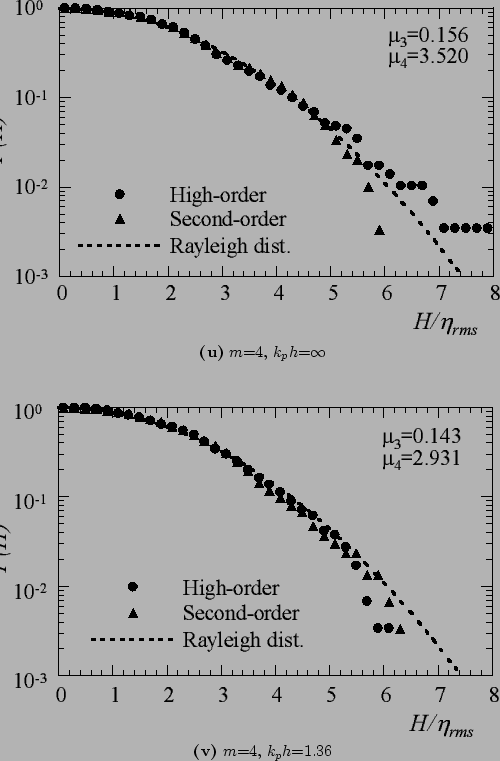
To verify the effects of the high-order nonlinearities on wave statistics quantitatively, time averaged ,
 , kurtosis:
 and skewness:
 are plotted in Figure 7 and Figure 8 as a function of initial spectrum band width and water-depth , respectively.
The vertical bars in the figures indicate variance of the statistics and bracket
are plotted in Figure 7 and Figure 8 as a function of initial spectrum band width and water-depth , respectively.
The vertical bars in the figures indicate variance of the statistics and bracket indicates time averaged value.
The difference of
indicates time averaged value.
The difference of
 between the high-order and the second-order solution is small.
However,
between the high-order and the second-order solution is small.
However,
 ,
,
 and
and
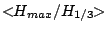 of the high-order solutions are larger than the second-order solution, and the differences between the high-order solution and the second-order one are decreased if the spectrum band width becomes broader in deep-water.
These differences are decreased in =2.0 and vanished in =1.36.
Moreover, they have opposite relationship in =1.0.
This imply that the high-order nonlinear effects play an important role to stabilize the waves in shallow-water.
The effects of the high-order nonlinearities are the most remarkable in .
The reason why stands out is that depends on the third-order nonlinearities in statistically (Longuet-Higgins, 1963).
Therefore, the value of is one of the milestones to check the influence of the high-order nonlinearities of the observed wave train.
of the high-order solutions are larger than the second-order solution, and the differences between the high-order solution and the second-order one are decreased if the spectrum band width becomes broader in deep-water.
These differences are decreased in =2.0 and vanished in =1.36.
Moreover, they have opposite relationship in =1.0.
This imply that the high-order nonlinear effects play an important role to stabilize the waves in shallow-water.
The effects of the high-order nonlinearities are the most remarkable in .
The reason why stands out is that depends on the third-order nonlinearities in statistically (Longuet-Higgins, 1963).
Therefore, the value of is one of the milestones to check the influence of the high-order nonlinearities of the observed wave train.