and
and  .
As a result, Eq.(13) can be simplified by using Eq.(7) and (21),
and are dropped for simplicity notation in the following contents.
.
As a result, Eq.(13) can be simplified by using Eq.(7) and (21),
and are dropped for simplicity notation in the following contents.
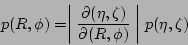
Let  =
=  and transform of variables from
  to
to
 express the joint probability density of the envelope
  and
and  in the form.
Transformation of Eq.(22) by Eq.(23) and its integration with regard to over [ ] yield the local wave amplitude distribution.
 is polynomial for (see Appendix).
Eq.(24) is the distribution with the parameters of  and
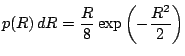
and  and agrees to the Rayleigh distribution.
This states that Eq.(24) could be treated as an extended distribution of the Rayleigh distribution.
Therefore, we should call Eq.(24) as the Edgeworth-Rayleigh distribution(or ER distribution).
and agrees to the Rayleigh distribution.
This states that Eq.(24) could be treated as an extended distribution of the Rayleigh distribution.
Therefore, we should call Eq.(24) as the Edgeworth-Rayleigh distribution(or ER distribution).
Assuming a weakly nonlinearity and narrow banded spectrum enables us to treat wave height  as two times of wave amplitude
  , that is, = 2.
Then the wave height distribution is calculated by Eq.(24).
, that is, = 2.
Then the wave height distribution is calculated by Eq.(24).
 is the wave height normalized by
  but its prime ' is dropped for simplicity hereafer.
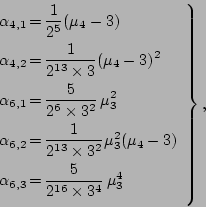
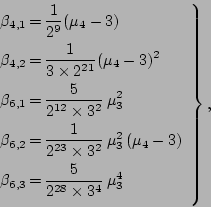
 are coefficients containing skewness and kurtosis of the water surface elevations,
 are polynomials for (see Appendix).
The exceedance probability of wave heights is given by integrating Eq.(26) over the range of  :
:
 are polynomials for (see Appendix).
An important point to be noted is that the first order correction to the wave amplitudes or wave heights is kurtosis(are related with
are polynomials for (see Appendix).
An important point to be noted is that the first order correction to the wave amplitudes or wave heights is kurtosis(are related with  and
and  ).
).
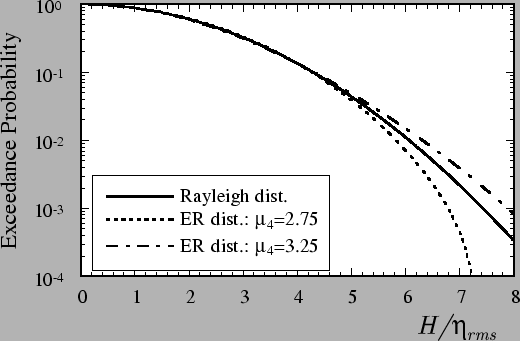
2 shows the exceedance probability of the wave heights for the case of
 =2.75 and 3.25 with
 =0.
The occurrence probability of the larger wave heights exceeds that of the Rayleigh distribution is increased when the value of
is larger than 3.
The value of kurtosis is dominated parameter for the PDF of wave heights.
=0.
The occurrence probability of the larger wave heights exceeds that of the Rayleigh distribution is increased when the value of
is larger than 3.
The value of kurtosis is dominated parameter for the PDF of wave heights.
![$\displaystyle p(\eta,\zeta) =
\frac{1}{2\pi}\exp\left[-\frac{1}{2}(\eta^{2}+\zeta^{2})\right]$](img78.png)
![$\displaystyle \hspace{0.5cm}
\times
\biggl[
1 + \frac{\kappa_{30}}{6}H_3(\eta)
+ \frac{\kappa_{40}}{24}H_4(\eta)
+ \frac{\kappa_{30}^2}{24}H_6(\eta)
\biggr]$](img79.png)
![$\displaystyle \hspace{0.5cm}
\times
\biggl[
1 + \frac{\kappa_{03}}{6}H_3(\zeta)
+ \frac{\kappa_{04}}{24}H_4(\zeta)
+ \frac{\kappa_{03}^2}{24}H_6(\zeta)
\biggr]$](img80.png)
![$\displaystyle \hspace{0.5cm}
\times
\left[ 1+\sum_{i=1}^{2}\alpha_{4,i}A_{4,i}(R)
+\sum_{i=1}^{3}\alpha_{6,i}A_{6,i}(R)
\right]
dR,$](img90.png)
![\begin{displaymath}
p(H') dH' = \frac{H'}{4}
\exp\left(-\frac{H'^2}{8}\righ...
...eft[ 1 + \sum_{i,j}\beta_{i,j}B_{i,j}(H')
\right] dH',
\end{displaymath}](img97.png)
![\begin{displaymath}
P(H)=\exp\left(-\frac{H^2}{8}\right)
\!\left[ 1 + \sum_{i,j}\beta_{i,j}E_{i,j}(H)\right]\!,
\end{displaymath}](img104.png)